
Did you know that WildSmart is a program of the Biosphere Institute, a local charity? Our work relies entirely on donations and sponsors. If you would like to support our community-based efforts to promote human-wildlife coexistence, please donate now!
BEAR ACTIVITY UPDATE (August 27, 2026)
(Banff National Park East Gate to Bow Valley Provincial Park)
There continues to be lots of bear activity within the Bow Valley and Kananskis Country and bears, especially black bears, have recently been seen in and around Canmore. There has been an increase in bear sightings in areas such as the Engine Bridge as bears are honing in on Dogwood berries and other natural vegetation. Fresh black bear scat was seen this morning along the river trails in Canmore (likely from last night) and it had lots of dogwood berries in it!
Dogwood is a big attractant for bears in the Bow Valley right now. It’s found in residential areas, along the river trails and at campgrounds throughout the Bow Valley. There has also been an uptick in bears in facility areas such as campgrounds and day use areas. Bears are actively searching for this food source and people need to be super vigilant in securing wildlife attractants, at home, on the trails and while camping and picnicking. Bears will have their heads down, focused on eating berries and other natural food sources which makes it crucial that we do not leave any food out (at home and on the trails). Any patch of berries, large or small, could be hiding a bear so people need to be cognizant of this. If you see berries - think bears! To avoid negative wildlife encounters, make lots of noise to alert wildlife of your presence, travel in groups, stay on designated trails, keep dogs on a leash at all times and be extra aware of your surroundings. IMPORTANT: If a bear is walking down the trail towards you (and if safe to do so), simply try moving off of the trail to let them pass, but always have your bear spray out and ready just in case. If the bear continues past, you were just in the way. If the bear turns to follow you, there is more going on and you should have your bear spray out and be ready to spray the bear.
There have been reports of people going into areas with bear closures in place. This is a significant safety risk to both the people who enter and the bears. Conservation Officers will charge anyone caught in an area closed due to bear activity!
Grizzly bears are starting to move up to and spend more time in higher elevations. However, for those remaining in the valley bottoms and near towns, their focus is on “easy to eat” meals such as garbage, fruit and berries in town. This time of year is very important for bears as they need to consume as many calories as possible to survive the upcoming winter hibernation. Those calories should not be coming from people or their yards as it poses a public safety risk and could cost a bear it’s life! We need to work together as a community to ensure that all fruit (including Dogwood, Crabapples, Cherries and Mountain Ash) are removed from trees NOW before a bear gets into them.
Did you Know? As per the Community Standards Bylaw in Canmore, 55.1- No Person or Owner shall permit or allow a Wildlife Attractant to be placed or remain in an outdoor location where it attracts Dangerous Wildlife. This means that if a bear is found feeding in your fruit tree, the first offence would be $1,000!
There are still funds available for the Town of Canmore’s Fruit Tree Removal and Replacement Incentive Programs so take advantage NOW before the money runs out AND before you attract a bear into town and/or get a large fine!
Properly managing and storing wildlife attractants at day use areas and campsites (such as food, drinks and garbage) is critical to prevent bears seeking out human food and getting into trouble. Bears are often coming through or spend time on the edges of the day use areas and campgrounds looking for berries, even when there are many people around. ALL attractants need to be secured in your vehicle, hard-sided trailer or bear-proof lockers. Never leave food and scented items in tents as bears can easily access them and always dispose of garbage in bear-proof bins. Never leave your food unattended - even for a minute!
Having a picnic? Whether you are sitting at a picnic table, or along a river or lake - try not to have too much food out on your table and do not let bears and other wildlife get any food rewards. If you are sitting and eating and a bear starts approaching your food and table - yell and shout to try and scare the bear away, do your best to secure your food by moving your food into your hard-sided vehicle/trailer or locker nearby, and use your bear spray to prevent the bear from getting that food reward. It is crucial that you do your best to make sure bears do not get any food rewards as it could result in bears getting relocated or killed. Your safety and the bear’s life might depend on it!
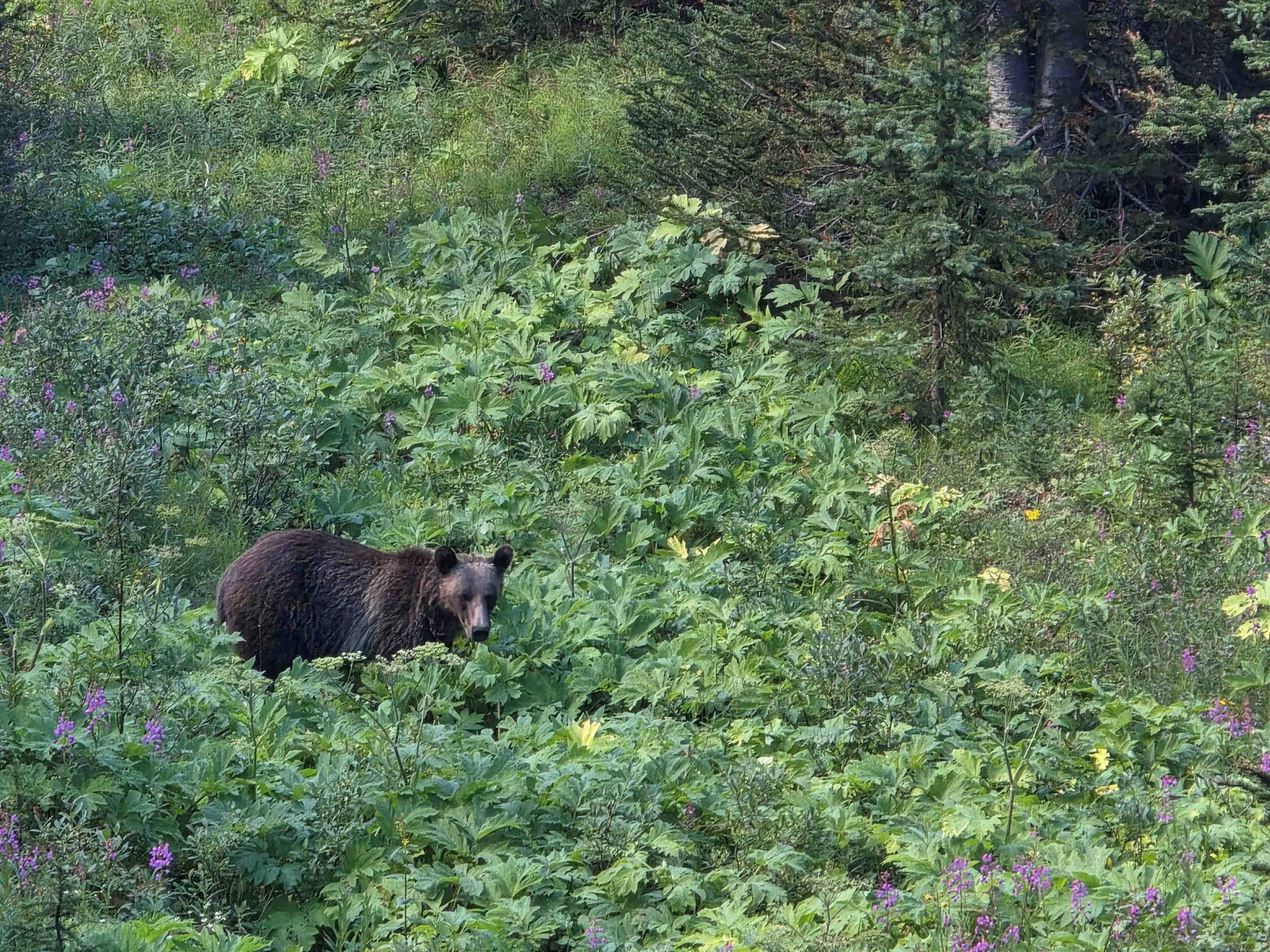
Grizzly bear enjoying the free salad bar down in Kananaskis Country on Aug.25, 2026.
VIEW CURRENT WARNINGS AND CLOSURES
Wildlife Closure - Woolley Trail due to wildlife feeding on a dead moose in the area. Woolley Trail is closed from the junction of Wheeler/Meadow Trails to Amos Trail.
A reminder to please report any sightings of a bear, cougar, wolf or any aggressive wildlife in the Bow Valley or K-Country to Kananaskis Dispatch at 403-591-7755. In Banff, call Dispatch at 403.762.1470. They prefer to get first hand reports from the people who see the wildlife!
SOME THINGS TO ‘BEAR’ IN MIND
GIVE THEM ROOM!
To trail users - If a bear is feeding along a trail, do not disturb it, and do not try to sneak past it. Wait until it leaves, turn around, or find another way around giving it lots of space. Don’t expect bears to move off a food source as they can be very possessive of their berry patches and may exert their dominance. Give them the space they need to forage undisturbed as these few weeks are the most important time for them to feed and take in these precious calories for their survival. It is not fair to the bear if you spray it while it is feeding and minding its own business just so you can walk past it. Remember you are in their backyard, not yours, so if they are behaving and doing what they are supposed to, we need to respect that, give them space (at least 100m) and leave them alone.
Other ways that you can give wildlife space include:
Mountain bikers and Trail Runners who are moving quickly (and often quietly) need to be extra vigilant and making lots of noise utilizing their voices (yelling and shouting) on the trails. Bears are feeding on berries very close to trails and bikers/runners are coming up on them quickly with little warning to the bears. In addition to letting wildlife know they are coming down the trail (by making noise), bikers/runners should slow down to avoid surprise encounters with wildlife, especially around blind corners, at the tops of hills, or in areas with thick vegetation and poor sight lines. They should also always be carrying bear spray.
During this busy summer season, there have been many bear jams, which puts unnecessary stress on the animals and causes public safety concerns. Motorists should obey posted speed limits and slow down near roadside wildlife - but don’t stop and cause (or be part of) a bear jam on the highway. Give bears at least 100m of space at all times and do not linger near wildlife feeding roadside - keep moving along and never get out of your vehicle! The Friends of Kananaskis Country have some great Tips for Roadside Wildlife Viewing for motorists and cyclists.
With all the focus on bears recently, it is important to mention that the elk rutting season is just around the corner. Elk continue to be seen regularly in Canmore and male elk are particularly protective of the female elk they are with. The best way to keep elk at ease is to stay at least 30m away - which is three school bus lengths - NEVER TRY TO SNEAK PAST THEM and never get between a male elk and the female elk.
Keep your dog on a leash at all times as it could save your life, your dog’s life and a bear’s life! If you are not able to do that, consider leaving them at home to give tired elk and deer some peace and quiet. Dogs can provoke defensive behaviour in bears and other wildlife so by keeping them on a leash, you are giving wildlife space they need and deserve. RELATED ARTICLE: Banff National Park tourist fined $1,500 for off-leash dog encounter with grizzly bear.
Giving wildlife space is crucial - watch this catchy video below to learn more!
Whether it's bears, wolves, cougars, elk, deer, sheep, or goats, all of the wildlife in the national parks will have a better chance of staying healthy and wild if we give them room.
WILDLIFE AMBASSADOR WORDS OF WISDOM
Living and recreating safely in bear country means understanding many things, from signs that bears are around, to what to do in a bear encounter. As we wander in the wilderness (or even in town sites) we are travelling in a bear’s home: their living areas, dining areas, and even their bathrooms. Recognizing the food sources that bears are currently eating can help raise your awareness of the possibility that bears are around where you are at any given moment. Every month we’re going to look at what bears are eating right now, and for the next few weeks, and in this edition of What are the Bears eating today? by Derek Ryder, Volunteer Wildlife Ambassador & IGA Interpretive Guide, it is Dogwood.
Every year, starting in late August or September – not long after the shepherdia berries are all eaten or have dried up – bears turn to another popular food: the berries of the Red Osier Dogwood bush, Cornus sericea. This is a plant with many names. It’s also called red brush, red willow, redstem dogwood, redtwig dogwood, red-rood, American dogwood, creek dogwood, and western dogwood. There are many other kinds of Dogwood in North America, but only Red Osier and its much smaller cousin, the Bunchberry, grow in Alberta. Red Osier Dogwoods look willow-like, but have distinctive red stems that turn even more red after the first frosts. Click here to read Derek’s full article about Dogwood!

Click on this image of Dogwood to read the article!
WEEKLY WILDLIFE AMBASSADOR WHEREABOUTS
In case you have not seen them yet, our amazing Volunteer Wildlife Ambassadors have been heading out onto trails and trailheads! You can find them talking to people about responsible trail use and staying safe while recreating in bear country. Note: their locations may change at the last minute. August 28 - Canmore River Loop
August 29 - Elbow Lake Pass
August 30 - Grassi Lakes Trail
FOOD FOR THOUGHT?
Dogwood berries are ripe and in the Bow Valley and these berries, along with other fruit trees and shrubs, are the main attractants that will draw bears into residential areas and NOW is the time to remove the fruit before a bear points out the problem. Leaving fruit (such as crabapple, mountain ash, chokecherry and dogwood) in your trees can attract bears into residential areas, putting bears and people at risk. The best practice is to remove fruit bearing trees and shrubs from your yard, however if you decide to keep your fruit bearing trees and shrubs, please ensure the fruit is removed BEFORE it is ripe! Canmore residents can be fined for letting fruit and berries accumulate on trees and on the ground in their yards as per the Community Standards Bylaw. It is your responsibility to make sure that bears do not have a reason to linger in your yard, resulting in bears being relocated or killed.
WildSmart has pruning shears and extendable pole saw pruners and fruit pickers that can be borrowed (free of charge) to assist Bow Valley residents in removing fruit and berry bushes from their property. Please send an email to resource@biosphereinstitute.org to make arrangements to borrow the fruit removal equipment.
If you prefer to remove and replace your fruit tree (recommended), there are still funds available for the Town of Canmore’s Fruit Tree Removal and Replacement Incentive Programs so take advantage NOW before the money runs out AND before you attract a bear into town and/or get a large fine! Applications are still open while limited funds are available so click here to apply now!

Black bear feeding on dogwood berries in the Three Sisters Area. Photo from Aug.23, 2018 by Witek Strzelecki.
WILDLIFE IN THE NEWS
WildSmart was on Global TV this week to talk about securing wildlife attractants.
Black bear scratches man’s leg on North Vancouver trail.
This Vermont resort town is crawling with bears and it’s dividing the local humans.
More grizzly bears killed in 2024 than any other year on record in Alberta.
Bear attacks, conflicts with humans reach historic levels in Colorado.
Woman Uses Jiu-Jitsu Training to Kick and Block Mother Bear’s Swipes during attack.
Black bear attacks woman, dog on back deck of property in Anmore, B.C.
Larimer County resident captures rare video of bear taking down elk.
Threatened trout spawning in Banff lake for first time in 50 years.
Bear and 2 coyotes cross paths in LA, with larger coyote appearing to defend smaller one.
CURRENT OPPORTUNITIES
The Biosphere Institute is hiring an Environmental Educator and Program Coordinator (Maternity Leave Contract) for our Future Leader Program, supporting the ecological literacy of children and youth in the Bow Valley. The Environmental Educator and Program Coordinator is responsible for organizing and delivering the Future Leaders programming including outdoor learning classes and field trips aligned with the Alberta curriculum, coordinating the Future Leaders Youth Council and maintaining strong relationships with funders while supporting the program’s fund development plan. The position will be based out of our office in Canmore.
This is a full-time maternity leave contract position, between 12 and 18 months in duration, with a start date of October 1, 2026. Click here for the full job description and requirements!
If you are interested in applying for this opportunity please email a resume and cover letter with the subject title “Future Leaders, Maternity Leave Contract” to education@biosphereinstitute.org by 5:00 p.m. MST on September 1, 2026.
AND NOW SOME PAWS-ITIVE NEWS
Giving wildlife room to roam: Y2Y at Planet Action TEDx
On November 15, 2025, the Yellowstone to Yukon Conservation Initiative’s (Y2Y) president and chief scientist Dr. Jodi Hilty stepped onto the TEDx stage at MIT with a radical yet elegant solution to stop biodiversity loss and address climate change — give nature room to move. Y2Y works to connect and protect wildlife habitat across a 3,200-kilometer corridor spanning Wyoming, Montana, Idaho, British Columbia, Alberta, and the Yukon. Speaking at Planet Action TEDx in Boston, a gathering of the world’s boldest environmental thinkers, Jodi made the case for something counterintuitive in our age of intervention and control. The best thing we can do for biodiversity and climate isn’t always to do more. Sometimes, it’s to create space for the wild to reclaim what it needs.
Her message comes at a critical moment. As species face unprecedented pressure and ecosystems teeter on the edge, large-scale conservation isn’t just an ideal. It’s happening, right now, across borders and generations.
What makes large-scale conservation work? - In her TEDx talk, Jodi emphasized three essential ingredients for success:
A compelling vision that inspires people to see nature as a shared legacy worth protecting
The best available science and knowledge to guide smart, effective decision-making and action, and
A strong and diverse community working together
UPCOMING EVENTS
Registration is now open for the 2026 Building for Sustainability Symposium!
Join us November 25–27 in Canmore for three days of learning, connection, and practical conversations about the future of the built environment.
This year’s Symposium explores the themes of Innovation | Collaboration | Small Changes, Big Impacts, bringing together builders, developers, architects, engineers, municipal leaders, sustainability professionals, and others working to create more resilient, efficient, and sustainable communities.
The program will feature engaging workshops and panel discussions, technical demonstrations, inspiring speakers, networking opportunities, and field trips showcasing real-world projects throughout the Bow Valley.
Whether you work directly in the building industry or are interested in how our communities can build better, we invite you to be part of the conversation.
Registration is now open. Explore the program and reserve your spot NOW!

Please remember BEARS CAN BE ENCOUNTERED ANYWHERE, ANYTIME!
Report any sightings of a bear, cougar, wolf or any aggressive wildlife in Kananaskis Country or the Bow Valley to Kananaskis Dispatch at 403.591.7755